Following a migrating planet: the comoving framework
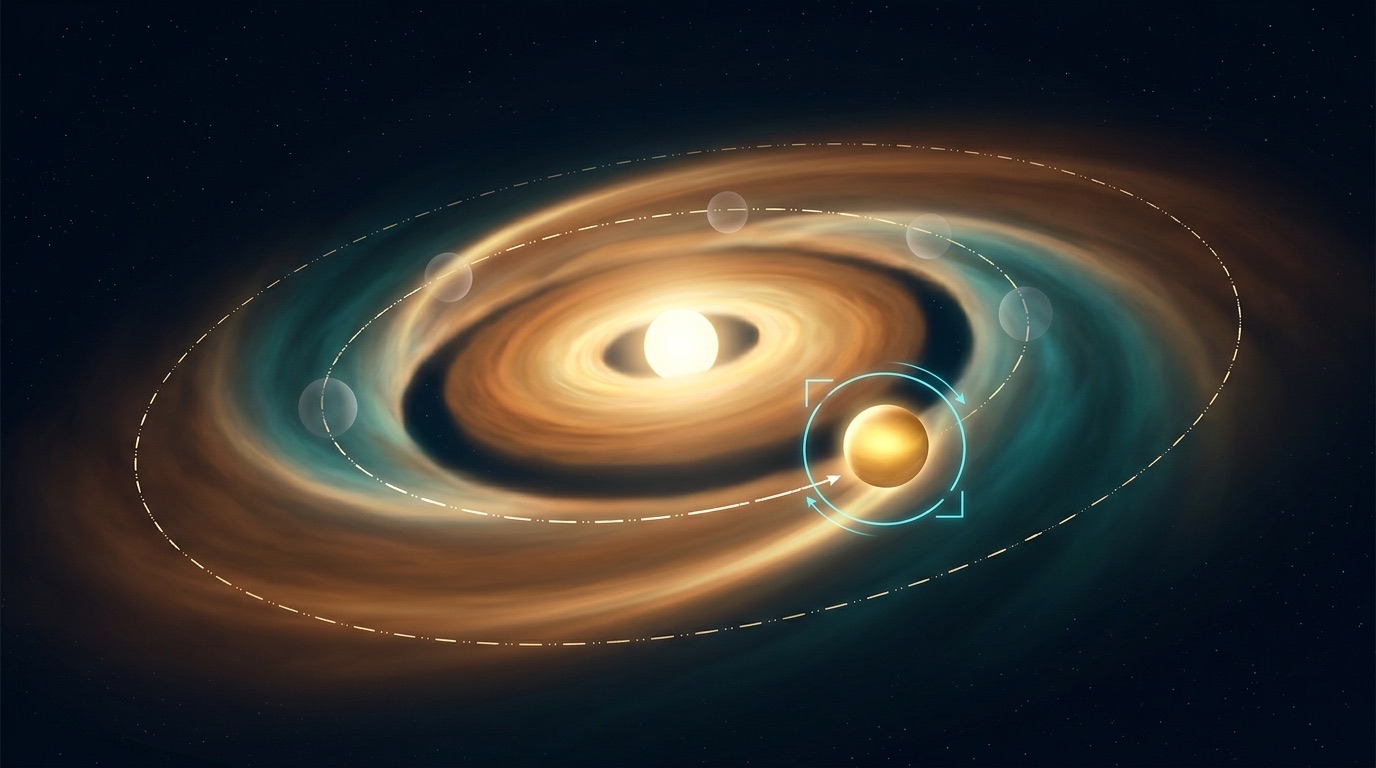
Companion research note — Transforming concepts from Ramos & Benítez-Llambay (2026) and Gomez et al. (2026) into simple intuition and real applications.
Eulerian and comoving reference frames
Simulating planet migration in a protoplanetary disk requires following a planet whose orbital radius changes over thousands of orbital periods. Standard Eulerian hydrodynamical codes discretize the disk on a spatially fixed radial grid: local resolution is high only where the mesh is refined around a fixed radius, so once the planet migrates away from its initial semi-major axis, it leaves that refined region.
An alternative is to formulate the equations in a comoving reference frame whose radial coordinate rescales dynamically with the planet’s semi-major axis \(a(t)\). In that frame, the planet remains stationary on the computational grid while the background disk flows radially across the mesh as \(a(t)\) evolves.
Limitations of fixed grids for long-range migration
Discretizing a protoplanetary disk on a spatially fixed Eulerian radial mesh introduces three practical limitations during long-range migration:
- Leaving the high-resolution zone: Modelers frequently stretch or concentrate radial cells around a planet’s starting orbit to resolve its Hill sphere and co-orbital flow. As the planet migrates inward or outward, it enters coarser cells and loses spatial resolution.
- Prohibitive global grids: Resolving the entire radial domain uniformly at Hill-sphere resolution increases cell counts and memory requirements substantially, restricting multi-thousand-orbit parameter surveys.
- Inner-boundary timestep limits: Even when a planet orbits at larger radii, small grid cells near the fixed inner radial boundary continue to limit the global CFL timestep, and long-range inward migration can eventually encounter the inner boundary.
How the comoving framework solves it
In Ramos & Benítez-Llambay (2026), rather than anchoring the radial mesh to static inertial coordinates, the fluid equations are formulated in comoving coordinates that rescale dynamically with the planet’s evolving semi-major axis.
In that comoving frame:
- The planet remains stationary relative to the local grid throughout the simulation.
- Local mesh refinement around the planet’s Hill sphere and horseshoe region remains centered on the planet during long-range inward or outward migration.
- Because the coordinate scale itself varies in time as the planet migrates, switching to the time-dependent comoving frame requires modifying the governing equations: the hydrodynamical continuity and momentum equations gain explicit non-inertial source terms involving the frame’s expansion/contraction rate (parametrized through \(H\) in the published formulation) and inertial accelerations. Including these source terms ensures angular momentum transport and spiral wave propagation remain consistent with the inertial frame.
Implemented in FARGO3D, this formulation achieves more than an order-of-magnitude (\(>10\times\)) computational speedup on long-range migration integrations compared with equivalent fixed-grid setups.
Applications in planet-migration studies
Reducing the cost of secular-timescale hydrodynamical migration expands the range of orbital-evolution problems that can be studied directly:
- Resonance capture & system assembly: Tracking planets across large radial excursions allows studies of how multi-planet chains converge into mean-motion resonances or migrate through structured disks without approaching grid boundaries.
- Dynamical trapping in dusty disks: Using this framework in
FARGO3D, PhD student José Gomez explored self-consistent two-fluid (gas + dust) migration across a 6-dimensional parameter space (Gomez et al. 2026). Allowing the planet to respond dynamically over long timescales revealed oscillatory radial confinement (dynamical attractors) that halt inward migration of super-Earths in dust-rich regions without requiring pre-existing pressure bumps.
Further reading: - Paper overview: a comoving framework for planet migration (Ramos & Benítez-Llambay 2026) - Paper overview: self-consistent migration and dynamical trapping (Gomez et al. 2026) - FARGO3D project page