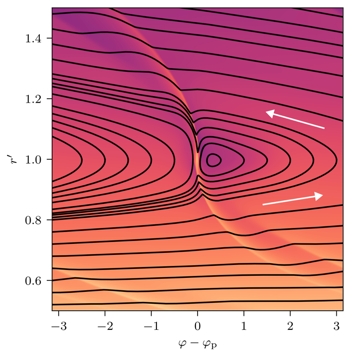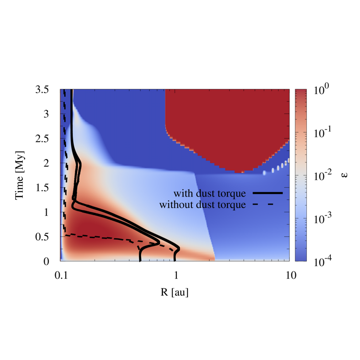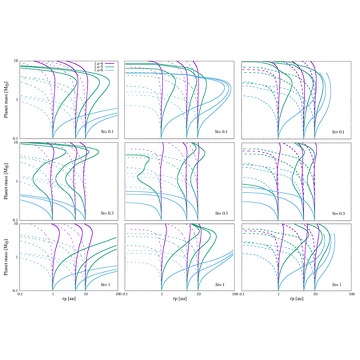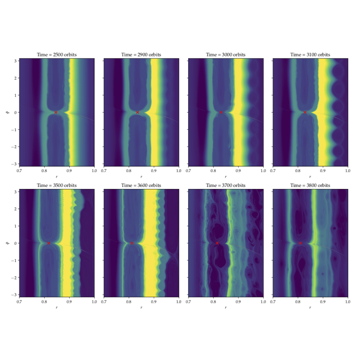

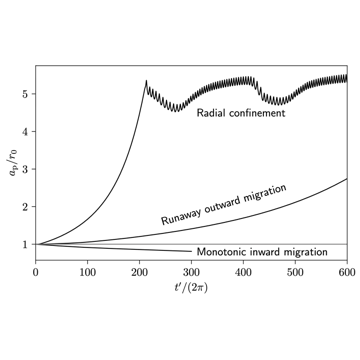
AI-generated summary: When planets migrate self-consistently in a comoving two-fluid frame rather than sitting on fixed orbits, coupled gas–dust feedback creates dynamical attractors where super-Earths are trapped in oscillatory radial orbits without needing pre-existing pressure bumps.
Read overview →
Publications
Refereed articles, conference proceedings, and book chapters
Every paper includes an inline AI-generated summary (), and selected works feature an expanded Overview page (also browsable in Paper overviews) with companion notes cross-linked to the Blog. For complete citation records, visit the ADS links from which you can export the bibliographic record in any format.
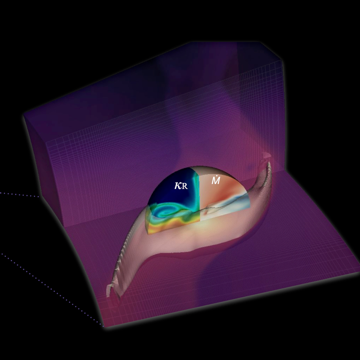
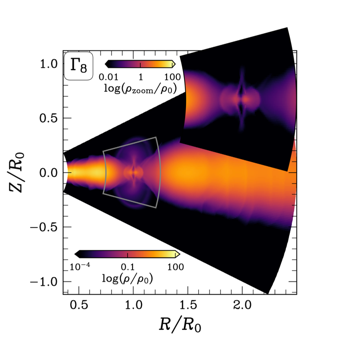
AI-generated summary: 3D FARGO3D simulations show that circumplanetary winds do not significantly alter the global disk, yet redirect local gas accretion from polar to equatorial latitudes and deplete the planet's Hill-sphere reservoir—potentially regulating giant planet growth.
Read overview →
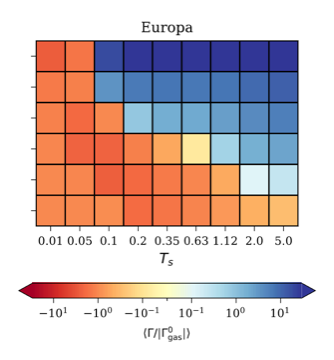
AI-generated summary: Two-fluid FARGO3D simulations of the circumjovian disk show that solid-driven torques can slow, halt, reverse, or accelerate satellite migration in a mass-dependent way, affecting satellite survival and resonance capture.
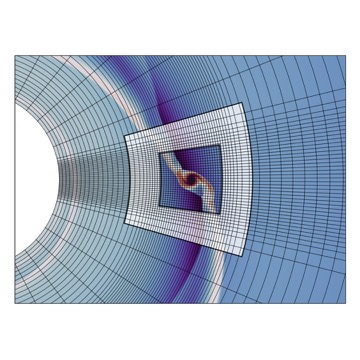
AI-generated summary: Introduces a comoving coordinate transformation in FARGO3D that keeps a migrating planet centered on its mesh, reducing the computational cost of long-range hydrodynamical migration simulations by more than an order of magnitude.
Read overview →
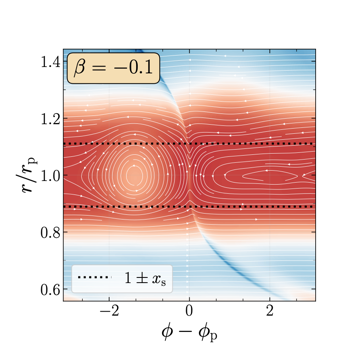
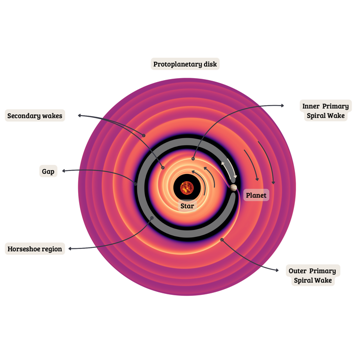
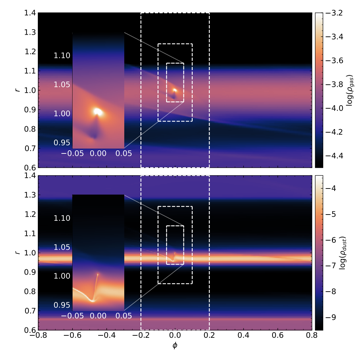
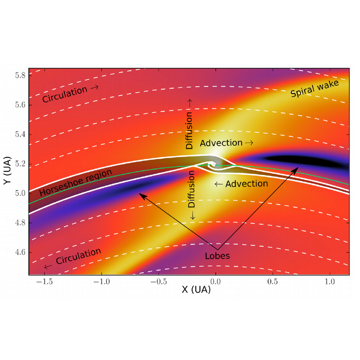
AI-generated summary: 2D hydrodynamical simulations show that L4–L5 gas asymmetry around gap-opening planets is governed by the radial temperature gradient (reversing sign with its slope) and shifts azimuthally with disk scale height.
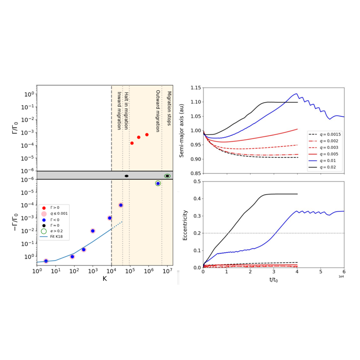
AI-generated summary: FARGO3D simulations in low-viscosity disks reveal a migration reversal around planet-to-star mass ratio q ≈ 0.002, with larger companions migrating outward when eccentricities remain modest (e < 0.2) and stalling at higher eccentricities.
AI-generated summary: Global planet-formation simulations combining dust evolution, pebble accretion, and dust torques show outward migration for cores inside the water-ice line, whereas outer-disk migration is moderated before pebbles drift inward.
AI-generated summary: An introductory review chapter summarizing the physical mechanisms of planet–disk interaction that drive orbital evolution and shape exoplanet system architectures.
AI-generated summary: 3D two-fluid nested-mesh simulations reveal that dust rings trap protoplanets on stable eccentric orbits—where intermittent thermal forces during ring passages halt migration and promote core growth.
AI-generated summary: 3D multi-fluid radiation-hydrodynamics simulations show circumplanetary disk formation requires cooling timescales much shorter than the orbital time; otherwise young giants host hot, pressure-supported envelopes.
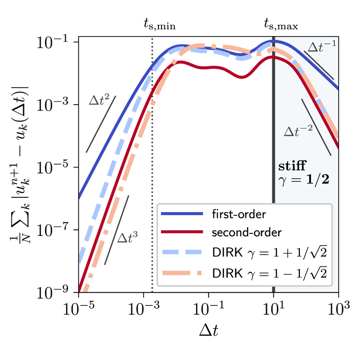
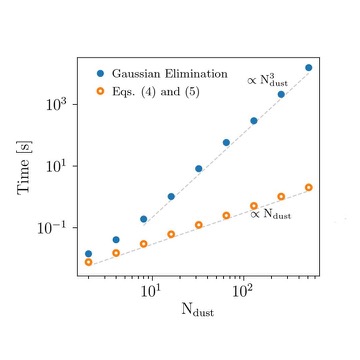
AI-generated summary: Introduces MDIRK, a second-order IMEX diagonally implicit Runge–Kutta solver for stiff multi-fluid dust–gas hydrodynamics that achieves an analytical O(N) velocity update while conserving total momentum to machine precision.
AI-generated summary: Generalizes fast orbital advection to arbitrary non-uniform meshes via operator splitting and conservative interpolation, achieving over an order-of-magnitude speedup with lower truncation errors.
Read overview →
AI-generated summary: Global quantification of scattered pebble torques on low-mass planets (< 10 M⊕), showing that dust torques can reverse inward Type I migration beyond the ice line for canonical dust-to-gas ratios and seed massive outer planets.
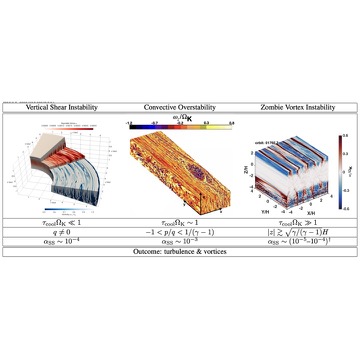
AI-generated summary: Protostars and Planets VII review synthesizing hydrodynamical instabilities, non-ideal MHD wind-driven accretion, coupled dust–gas back-reaction instabilities, and connections to ALMA disk substructures.
AI-generated summary: Derives the exact analytical O(N) velocity update for the implicit multi-fluid drag solver of Benítez-Llambay et al. (2019) when dust species exchange momentum only with the gas, eliminating O(N^3) matrix inversions.
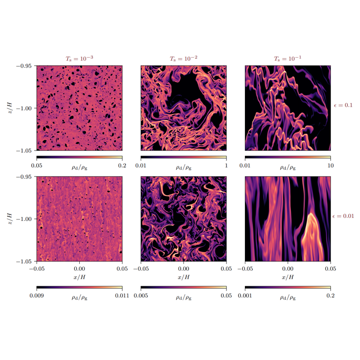
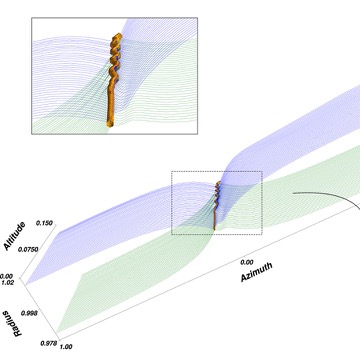
AI-generated summary: Linear stability analysis and FARGO3D simulations of the Dust Settling Instability show that vertical dust settling relative to gas drives instabilities above the midplane that clump grains before they reach the midplane layer.
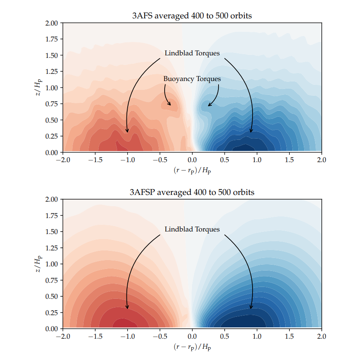
AI-generated summary: 3D hydrodynamic simulations of low-mass planets in wind-driven inviscid disks show that buoyancy resonances alter co-orbital vortensity, turning the 3D dynamical corotation torque negative and accelerating inward migration.
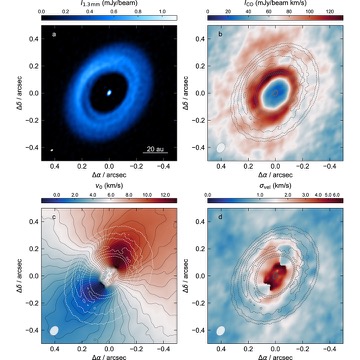
AI-generated summary: Long-baseline ALMA 1.3 mm continuum and 12CO kinematics of HD 100546 reveal fine-scale concentric ridges and trenches alongside localized ~90° velocity wiggles matching perturbations from an embedded massive protoplanet.
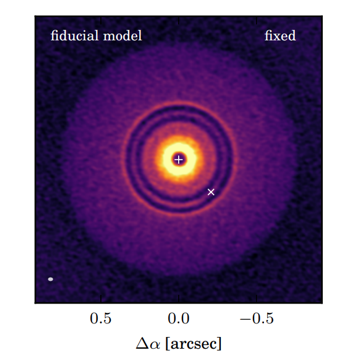
AI-generated summary: Multi-fluid FARGO3D hydrodynamics and RADMC-3D radiative transfer show that a Neptune-mass planet migrating in a low-viscosity disk produces three or more concentric dust rings whose spacing encodes the planet's migration speed and direction.
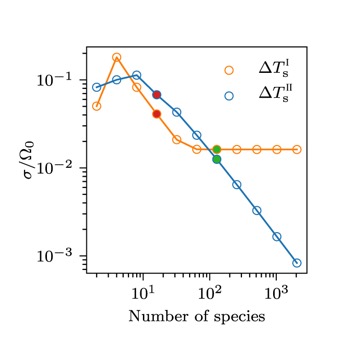
AI-generated summary: Linear stability analysis of the streaming instability with a continuous particle-size distribution, showing that growth rates decrease significantly compared to single-size models unless dust is locally concentrated or size-sorted.
Read overview →
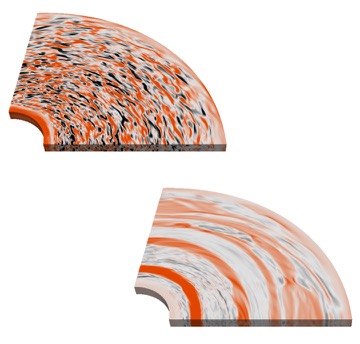
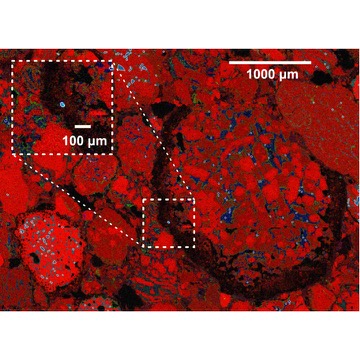
AI-generated summary: Combines chondrite laboratory measurements with 2D planet–disk dust-filtration simulations to constrain protosolar disk viscosity and surface density from how early Jupiter and Saturn gaps filtered CAI-sized grains.
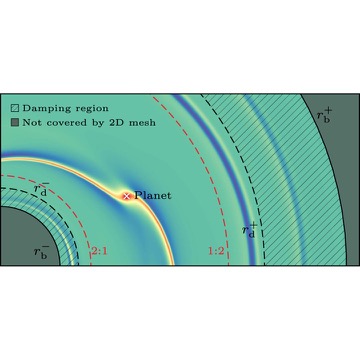
AI-generated summary: 2D simulations of migrating super-Earths in low-viscosity, laminar accretion disks identify non-linear regimes shaped by wave-damping feedback, gap-edge vortices, and background accretion flows.
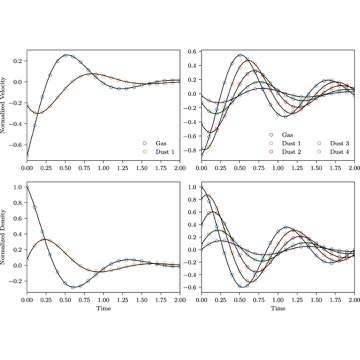
AI-generated summary: Introduces a general implicit, unconditionally and asymptotically stable solver for momentum transfer between N fully coupled fluids conserving total momentum to machine precision, and presents a multi-fluid test suite in FARGO3D (with the O(N) analytical gas–dust update later derived in Krapp & Benítez-Llambay 2020).
Read overview →
AI-generated summary: 3D non-ideal MHD and multi-fluid simulations in NIRVANA-III and FARGO3D show that Hall-dominated turbulence self-organizes magnetic flux into long-lived zonal flows and vortices that trap and segregate dust grains.
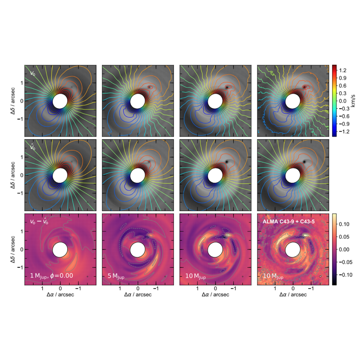
AI-generated summary: 3D hydrodynamical and radiative transfer modeling demonstrates that planet-induced gaps, spirals, and vortices leave measurable non-Keplerian shifts in ALMA CO line-centroid velocity maps that scale with planet mass.
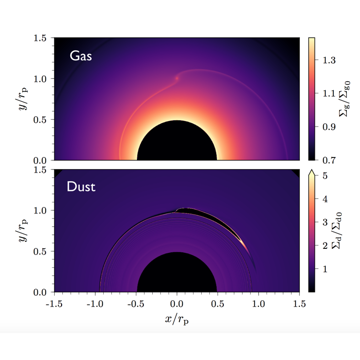
AI-generated summary: Demonstrates that drifting pebbles gravitationally scattered by an embedded planetary core create an asymmetric dust wake that exerts a net torque—capable of slowing, halting, or reversing inward Type I migration.
Read overview →
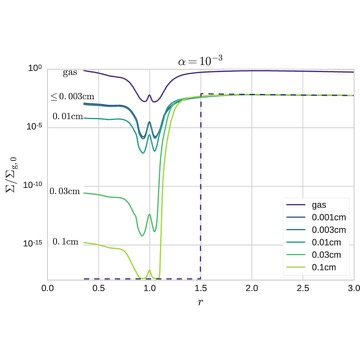
AI-generated summary: Long-term 2D multi-fluid simulations quantify how planet-induced gas gaps selectively filter drifting dust grains above a critical size that depends on disk viscosity, disk mass, and planet mass.
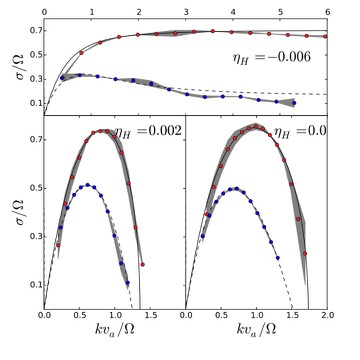
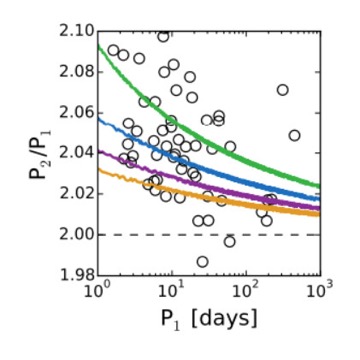
AI-generated summary: Analytical and numerical models of convergent Type-I migration in flared disks reproduce the period-ratio offsets of Kepler's near-resonant 2:1 and 3:2 close-in exoplanet pairs without invoking tidal dissipation.
AI-generated summary: Presents numerical implementations of non-ideal MHD effects—Ohmic resistivity, ambipolar diffusion, and the Hall effect—for stable, efficient integration in grid-based astrophysical MHD codes such as FARGO3D.
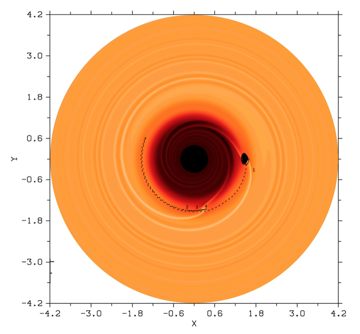
AI-generated summary: Introduces a radial mesh-shifting and remapping method in FARGO3D that tracks migrating planets across the disk, enabling hydrodynamical simulations over disk-lifetime timescales at low computational cost.
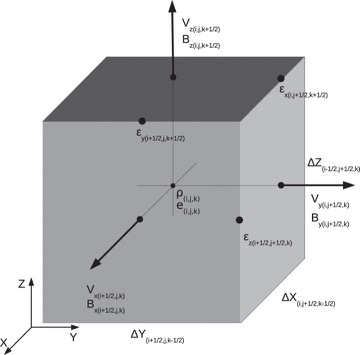
AI-generated summary: Introduces the public CPU/GPU MHD code FARGO3D, featuring constrained transport, fast orbital advection, an N-body integrator, and an automatic C-to-CUDA parser that translates C functions into CUDA kernels at compilation time.
Read overview →
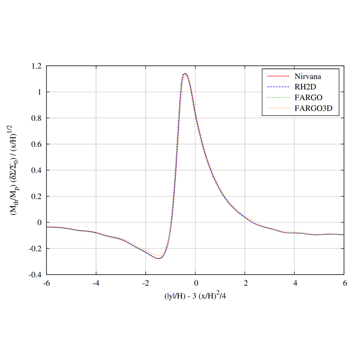
AI-generated summary: Applies Ertel's theorem and Bernoulli invariance in 3D globally isothermal disks to show that the horseshoe separatrix is cylindrical and derive an analytical 3D horseshoe drag formula validated against simulations.
AI-generated summary: Identifies the 'heating torque': accretion luminosity from a growing planetary core warms surrounding disk gas asymmetrically, generating a positive torque that can slow, stall, or reverse inward Type I migration.
Read overview →
AI-generated summary: Benchmarks upwind, Riemann-solver, and FARGO orbital-advection schemes across 2D and 3D isothermal and adiabatic setups to establish resolution and numerical requirements for low-mass planets in nearly inviscid disks.
AI-generated summary: Tests synthetic radial-velocity observations of 1:1 co-orbital (Trojan and horseshoe) planets, showing how sparse datasets can confuse co-orbital pairs with single planets or unstable 2:1 resonant fits.
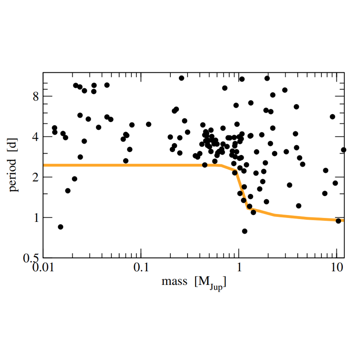
AI-generated summary: Models planet–disk interaction near an inner disk cavity (~2 days) together with stellar tides to explain why sub-Jovian planets pile up beyond P ≈ 2.5 days while >1 MJ hot Jupiters cross the gap and migrate inward by tides.
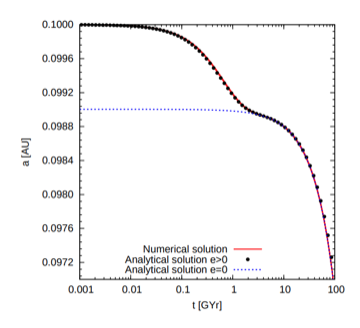
AI-generated summary: Develops an analytical formulation of secular semi-major axis and eccentricity evolution under stellar tidal dissipation to model the inward migration and orbital decay of close-in exoplanets.
No matching items