Momentum transfer between gas and dust
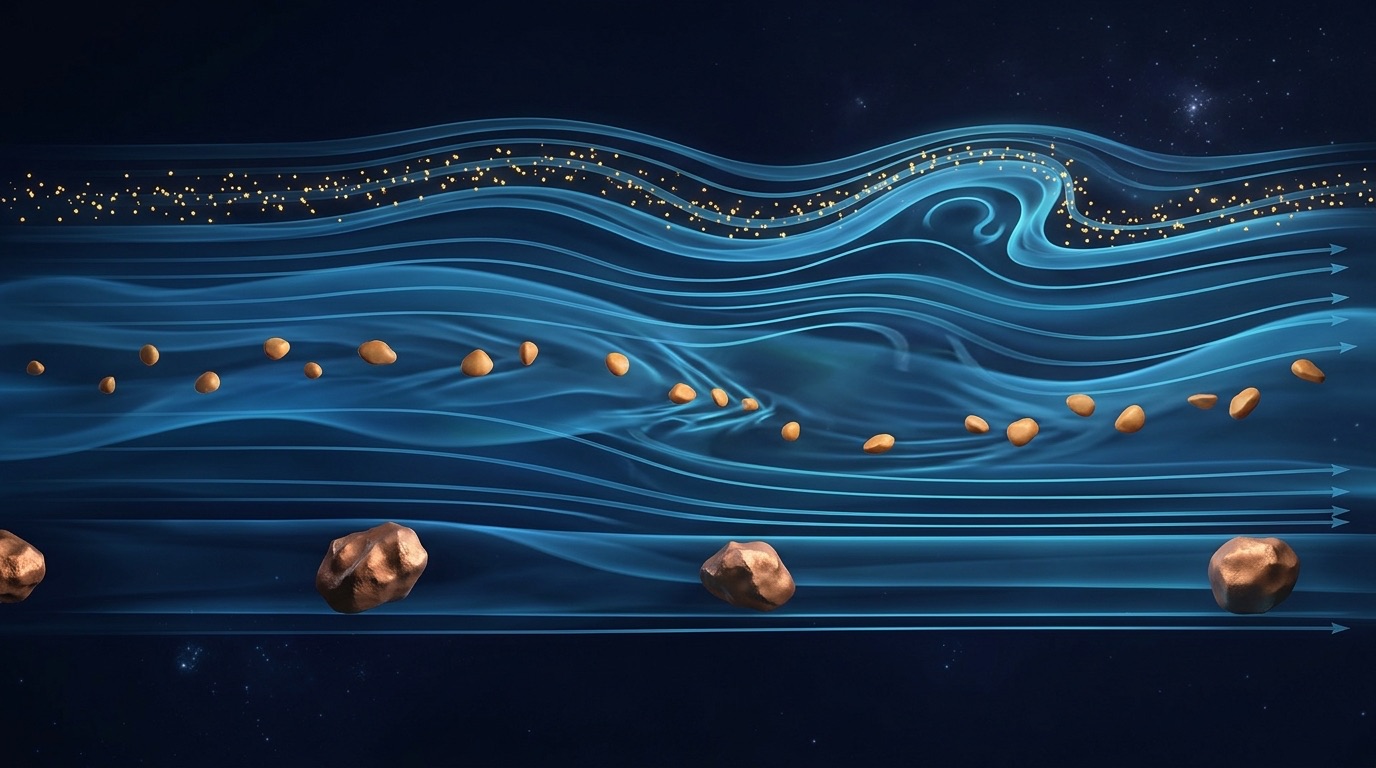
Companion research note — Transforming concepts from Benítez-Llambay, Krapp, & Pessah (2019) and Krapp & Benítez-Llambay (2020) into intuition and real-world applications in FARGO3D.
Aerodynamic drag and stopping timescales
In a mixture of gas and solid particles, aerodynamic coupling is governed by the particle stopping time \(\tau_s\)—the characteristic timescale for drag forces to damp the relative velocity between a grain and the surrounding gas—and its dimensionless counterpart in a Keplerian disk, the Stokes number \(\mathrm{St} = \tau_s \Omega_K\):
- Small grains (\(\mathrm{St} \ll 1\)): Momentum exchange occurs on timescales much shorter than the orbital period, keeping fine dust tightly coupled to the gas velocity field.
- Intermediate particles (\(\mathrm{St} \sim 1\)): Grains experience appreciable aerodynamic drag over one orbital timescale, driving maximum radial drift relative to the pressure-supported gas.
- Large bodies (\(\mathrm{St} \gg 1\)): Stopping times greatly exceed the orbital timescale, so massive bodies follow nearly Keplerian trajectories perturbed only weakly by gas drag.
Whenever the local dust-to-gas mass ratio \(\epsilon = \rho_d / \rho_g\) approaches or exceeds unity, momentum conservation requires accounting for two-way momentum feedback: not only does the gas accelerate the dust, but the dust exerts an equal and opposite back-reaction force on the gas.
Consequences in protoplanetary disks
In circumstellar disks, gas and dust coexist throughout the disk yet obey different force balances: gas is partially supported against gravity by radial pressure gradients, whereas dust particles are pressureless. Two-way aerodynamic drag between them produces several dynamical effects:
- Radial drift & grain sorting: Disk gas orbits the central star slightly slower than the Keplerian speed because of outward radial pressure support. Solid particles experience this velocity difference as a headwind, lose angular momentum, and drift radially inward at rates dependent on \(\mathrm{St}\).
- Scattered pebble torques on planets: When an embedded planet gravitationally perturbs drifting solids, pebbles are deflected into asymmetric wakes that the pressure-supported gas cannot match. The resulting dust distribution exerts net positive torques that can slow or reverse inward planetary migration (Benítez-Llambay & Pessah 2018).
- Dust concentration & planetesimal formation: Collective two-way drag between drifting solids and gas drives the streaming instability, concentrating particles into dense filaments that can undergo gravitational collapse into planetesimals. However, distributing momentum across a continuous grain-size spectrum lowers linear growth rates substantially unless solids first segregate or concentrate locally (Krapp et al. 2019).
Numerical stiffness and implicit time integration
Astrophysical dust–gas mixtures—and protoplanetary disks in particular—span grain sizes from microns to centimeters simultaneously. Integrating \(N\) interacting fluid equations numerically becomes challenging when stopping times are short relative to the orbital timescale:
- Stiffness from small grains: Micron-sized dust has a stopping time orders of magnitude shorter than the orbital period. An explicit drag integrator becomes numerically unstable when the timestep \(\Delta t\) exceeds the shortest stopping time, restricting \(\Delta t\) across the entire 3D simulation.
- Cost of general matrix inversion: An implicit backward-Euler update avoids that timestep restriction by solving all \(N\) fluid velocities simultaneously. In Benítez-Llambay, Krapp, & Pessah (2019), we derived the general solution for \(N\) fully coupled fluids, where every fluid can exchange momentum directly with every other fluid. That general method is unconditionally and asymptotically stable, conserves total momentum to machine precision, and recovers the exact terminal-velocity / center-of-mass equilibrium in the stiff limit—but because all fluids may couple to one another, solving the full \(N \times N\) linear system scales as \(O(N^3)\) per cell.
From the general 2019 solver to the analytical \(O(N)\) solution (Krapp & Benítez-Llambay 2020)
In protoplanetary disks, however, dust species exchange momentum predominantly with the gas rather than colliding directly with each other. Consider one gas fluid (\(g\)) coupled to \(N-1\) dust species (\(k = 1, \dots, N-1\)):
\[\frac{d\mathbf{v}_g}{dt} = -\sum_{k} \epsilon_k \frac{\mathbf{v}_g - \mathbf{v}_k}{\tau_k} + \mathbf{a}_g, \qquad \frac{d\mathbf{v}_k}{dt} = -\frac{\mathbf{v}_k - \mathbf{v}_g}{\tau_k} + \mathbf{a}_k\]
where \(\epsilon_k = \rho_k / \rho_g\) is the dust-to-gas mass ratio of species \(k\), \(\tau_k\) is its aerodynamic stopping time, and \(\mathbf{a}_g, \mathbf{a}_k\) are external accelerations (such as gravity or gas pressure forces).
Because the dust species exchange momentum only with the gas, the implicit coupling matrix of the 2019 method becomes sparse (with non-zero off-diagonal couplings restricted to the gas row and gas column). Exploiting that structure, Krapp & Benítez-Llambay (2020, RNAAS, 4, 198) derived the exact closed-form analytical solution to the 2019 implicit update.
In the drag-only step (\(\mathbf{a}_g = \mathbf{a}_k = 0\)), expressing each updated dust velocity \(\mathbf{v}_k^{n+1}\) directly in terms of the updated gas velocity \(\mathbf{v}_g^{n+1}\) gives:
\[\mathbf{v}_k^{n+1} = \frac{\mathbf{v}_k^n + (\Delta t / \tau_k)\,\mathbf{v}_g^{n+1}}{1 + \Delta t / \tau_k}\]
Substituting that relation back into the gas equation isolates \(\mathbf{v}_g^{n+1}\) analytically:
\[\mathbf{v}_g^{n+1} = \frac{\mathbf{v}_g^n + \sum_{k} \dfrac{\epsilon_k (\Delta t / \tau_k)}{1 + \Delta t / \tau_k}\,\mathbf{v}_k^n}{1 + \sum_{k} \dfrac{\epsilon_k (\Delta t / \tau_k)}{1 + \Delta t / \tau_k}}\]
With external accelerations (\(\mathbf{a}_g, \mathbf{a}_k\)), the same closed-form derivation yields an exact analytical update in \(O(N)\) operations instead of \(O(N^3)\), while preserving every property of the general 2019 method:
- Linear \(O(N)\) scaling (Krapp & Benítez-Llambay 2020), enabling GPU execution across many grain sizes simultaneously.
- Unconditional and asymptotic stability (Benítez-Llambay, Krapp, & Pessah 2019): remains stable for arbitrarily small stopping times and arbitrary dust-to-gas mass ratios while recovering the coupled center-of-mass / terminal-velocity limit.
- Machine-precision momentum conservation: Total momentum \(\rho_g \mathbf{v}_g + \sum_k \rho_k \mathbf{v}_k\) is conserved identically at every step in FARGO3D.
Further reading: - Paper overview: asymptotically stable multispecies momentum transfer in FARGO3D (Benítez-Llambay, Krapp, & Pessah 2019) - Analytical O(N) velocity update: Krapp & Benítez-Llambay (2020, RNAAS, 4, 198) - Polydisperse streaming instability (Krapp et al. 2019) - FARGO3D project page